
GCWUF hosts NPBPA-2026, a 3-day natural products conference in Faisalabad on Nov 25–27. The speakers, sessions, the AI docking workshop, the expo and why it matters.
Pakistan has always had a close relationship with plants that heal. Most households still keep a jar of honey for sore throats, a bit of turmeric in the spice tin and someone’s grandmother ready with advice about ajwain or kalonji. What has been missing for a long time is a serious, organised effort to test that knowledge in the lab, standardise it and turn it into products people can trust.
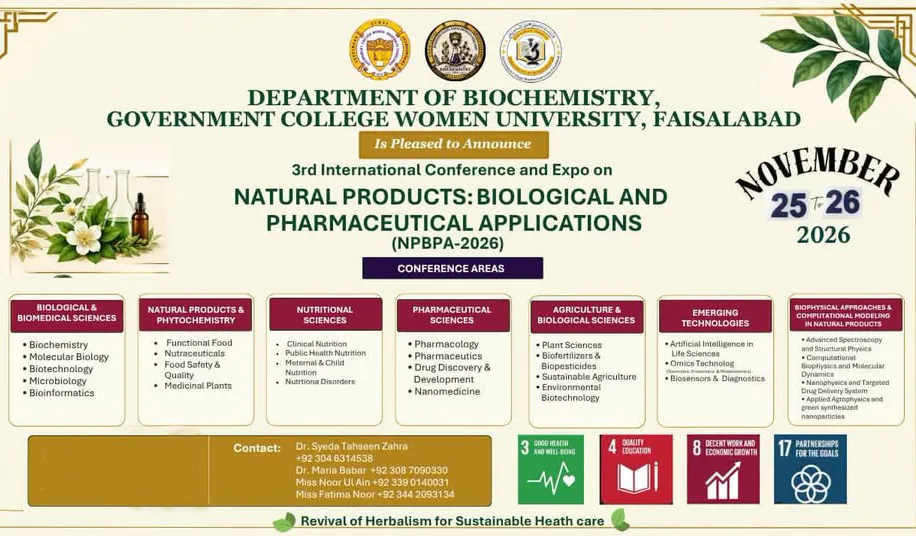
This week, Government College Women University Faisalabad (GCWUF) is trying to close that gap. The university is hosting the 3rd International Conference and Expo on Natural Products: Biological and Pharmaceutical Applications (NPBPA-2026) from November 25 to 27, 2026. The event is organised by the Faculty of Science and Technology, and the Department of Biochemistry is one of its main drivers. The conference slogan sums up the mood: “Revival of Herbalism for Sustainable Health Care.”
Quick Facts at a Glance
| Detail | Information |
|---|---|
| Event | 3rd International Conference & Expo on Natural Products: Biological and Pharmaceutical Applications |
| Short name | NPBPA-2026 |
| Dates | November 25–27, 2026 (Wednesday to Friday) |
| Venue | Government College Women University, Faisalabad (main sessions in Jinnah Auditorium) |
| Organiser | Faculty of Science & Technology, GCWUF |
| Patron-in-Chief | Prof. Dr. Kanwal Ameen (T.I.), Vice Chancellor, GCWUF |
| Patron | Prof. Dr. Aysha Sameen, Coordinator, Faculty of Science & Technology |
| Format | Physical and online (with international speakers joining virtually) |
| Highlights | Plenary talks, oral & poster presentations, AI workshop, product expo, networking |
What Is NPBPA-2026 About?
The organisers say the goal is to bring researchers, academics, industry experts and students together to share knowledge, look at new ideas and build working partnerships in natural products, life sciences and pharmaceutical sciences. Their tagline, “Harnessing Nature’s Potential for a Healthier Tomorrow,” shows what they have in mind.
The program five objectives:
- A platform for knowledge exchange and research collaboration.
- Scientific exploration of natural products and what they can do therapeutically.
- Innovation in drug discovery, phytochemistry and biotechnology.
- Connecting academia, industry and regulators so the work leads to sustainable healthcare solutions.
- Supporting young researchers and students with exposure to advanced research and career options.
That fourth point matters more than it looks. In Pakistan, a lot of good plant research stays inside a thesis. It never reaches a pharmacy shelf or a food factory. A conference that puts a vice chancellor, a food-industry CEO and a PhD scholar in the same room at least gives that research a chance to go further.
The event also lines up with four UN Sustainable Development Goals: SDG 3 (Good Health and Well-being, SDG 4 (Quality Education), SDG 8 (Decent Work and Economic Growth) and SDG 17 (Partnerships for the Goals).
Related reading on Being Journalist: more education news from Pakistani universities.
Conference Themes: Eight Research Areas
The programme is organised around eight broad tracks. Together they show how wide the field of “natural products” has become.
1. Biological & Biomedical Sciences
Biochemistry, molecular biology, biotechnology, microbiology and bioinformatics.
2. Natural Products & Phytochemistry
Functional foods, nutraceuticals, food safety and quality, and medicinal plants.
3. Nutritional Sciences
Clinical nutrition, public health nutrition, maternal and child nutrition, and nutritional disorders.
4. Pharmaceutical Sciences
Pharmacology, pharmaceutics, drug discovery and development, and nanomedicine.
5. Agriculture & Biological Sciences
Plant sciences, biofertilisers and biopesticides, sustainable agriculture and environmental biotechnology.
6. Emerging Technologies
Artificial intelligence in life sciences, omics technologies, biosensors and diagnostics.
7. Food Science & Technology
Food preservation, herbal and functional foods, and turning food waste into value-added products.
8. Biophysical Approaches & Computational Modelling
Advanced spectroscopy, computational biophysics, molecular dynamics, nanophysics, targeted drug delivery and green-synthesised nanoparticles.
Having a physics-led track next to nutrition and agriculture is a good sign. Natural product research now depends on spectroscopy, simulations and nanotechnology as much as it depends on extraction and lab assays.
Day 1 : Wednesday, November 25: Opening Day
Inaugural Session (Jinnah Auditorium, 9:00 am – 12:15 pm)
The conference opens with recitation from the Holy Qur’an, Naat Shareef and the national anthem. Dr. Mubshara Saadia, Chairperson of the Department of Biochemistry and Chief Organizer, gives the welcome note.
A strong line-up of guests of honour follows:
- Prof. Dr. Shahzad Sarfaraz, Director, FAST (Chiniot-Faisalabad Campus)
- Prof. Dr. Amman Ullah Malik, Rector, The University of Faisalabad
- Prof. Dr. Faheem Aftab, Vice Chancellor, University of Jhang
- Prof. Dr. Rauf-i-Azam, Vice Chancellor, Government College University Faisalabad
- Prof. Dr. Kanwal Ameen (T.I.), Vice Chancellor, GCWUF
The biggest announcement of the morning has nothing to do with speeches. GCWUF will launch new BS and MS programmes in “Natural Products Development,” run by the Department of Biochemistry, with admissions opening in 2027. Students who want a career in herbal pharmaceuticals, nutraceuticals or functional foods should note this one. Degree programmes built specifically around natural product development are still rare in Pakistan.
The morning also includes a segment celebrating the Pakistan–China space mission, the distribution of souvenirs and a visit to the student product expo.
If you are planning your studies, see our admissions and scholarships coverage.
Plenary Session: Voices from the Field (12:15 pm – 2:00 pm)
This session will probably draw the biggest crowd on day one. A few talks stand out:
- Prof. Dr. Amer Jamil (former Dean of Sciences, UAF): “From 3,000 Peptides to 1 Therapeutic Lead: How Bioinformatics Is Revolutionizing Drug Discovery.” The title tells you a lot about how drug discovery works now. Computers do the first round of screening, which saves years of lab work.
- Dr. Habib Aslam Gaba (Chairman, FCCI Standing Committee on Industrial-Academia Linkages): “Knowledge Economy and the Revival of Herbalism for Sustainable Health.” This is the business case for herbal research.
- Prof. Dr. Muhammad Umair Arshad (GCUF): cheese whey valorisation and sustainability.
- Prof. Dr. Atta ur Rehman Khan (King Abdullah International Medical Research Centre, Riyadh): malnutrition as a prognostic factor in hospitalised patients.
- Prof. Dr. Shahid Iqbal (University of Education): natural antioxidants from kitchen waste for clean-label foods.
- Prof. Dr. Tusneem Kausar (University of Sargodha): “Natural Food Toxins: Hidden Hazards in Everyday Foods.”
- Prof. Dr. Shinawar Waseem Ali (University of the Punjab): Aloe vera as an underused source of bioactives in Pakistan.
Afternoon Technical Sessions (2:30 pm – 4:05 pm)
Four sessions run in parallel after lunch.
Technical Session I: Biological & Biomedical Sciences (Jinnah Auditorium). The keynote is by Prof. Dr. Anjum Zia (UAF) on stevia-based food and pharmaceutical products. Prof. Dr. Tahir Mahmood (Punjab University) speaks on DNA barcoding of Berberis lycium. Two online talks from Karakoram International University cover medicinal plants of Gilgit-Baltistan, including Gentianodes tianschanica. Talks on in silico drug discovery and maize bran arabinoxylan complete the session.
Technical Session II: Pharmaceutical Sciences (Multipurpose Center). This session covers a face serum made from papaya, metabolites from Aspergillus flavus, green-synthesised silver nanoparticles from fenugreek for liver protection, ZIF-8 corn starch films that keep apples fresh, and biotechnology-driven “green molecules.”
Technical Session III: Natural Products & Phytochemistry (Seminar Room-I). Topics include probiotic microencapsulation, breastfeeding practices in Lahore, indigenous apple gourd (tinda) as a functional food, and three GCWUF talks on food waste valorisation, including mango peel pectin and jamun seed coatings for fruit preservation.
Technical Session IV: Nutritional Sciences (Video Conference Room). Dr. Muhammad Asif Khan (Islamia University Bahawalpur) gives the keynote on oat bran beta-glucan. Another talk I’d recommend comes from Dr. Maham Tabassum: “Natural Doesn’t Mean Harmless: Clinical Implications of Herb-Drug Interactions.” This message needs to reach the public. Many patients take herbal remedies alongside prescription drugs and never tell their doctor. The U.S. National Center for Complementary and Integrative Health keeps a useful public guide on exactly this issue. The session also covers microgreens, lifestyle medicine and psychobiotics for mental health.
Technical Session V: The AI Workshop (NAVTECH Lab, 12:20 pm – 4:00 pm)
For students, this may be the most practical part of the whole conference. Dr. Muhammad Tahir Akhtar from the University of Lahore’s International Centre for Interdisciplinary Research in Sciences runs a hands-on training on molecular docking and virtual screening of natural products. It covers therapeutic target selection, protein–ligand interaction analysis and molecular visualisation.
Day 2 : Thursday, November 26: The Busiest Day
Morning Inaugural Session
Day two opens with a welcome from Dr. Ayesha Younas, Chairperson of the Department of Physics. Remarks follow from Ch. Jawaid Yousaf (CEO, Dawn Bread / Mahboob Food Industries) and Prof. Dr. Ilyas Tariq (Superior University, Sargodha). Prof. Dr. Shahzad Basra, former Chairman of Crop Physiology at UAF, gives a plenary talk.
Having the head of a major food company on stage is a deliberate choice. Industry presence is what turns a research conference into a place where real partnerships can start.
Technical Session VI: Agriculture & Biological Sciences
Highlights include:
- Prof. Dr. Muhammad Riaz (BZU): “From Waste to Wealth”, about the valorisation of Citrullus colocynthis (bitter apple).
- Prof. Dr. Muhammad Issa Khan (NIFSAT, UAF): natural products for managing lifestyle disorders.
- Prof. Dr. Muhammad Aamer Mehmood (GCUF): microalgae for circular biomanufacturing.
- Eng. Dr. Azhar Ali (Business Incubation Center, UAF): “From Raw Botanicals to Standardized Dosages: The MoringUp Entrepreneurial Journey.” This is a real start-up story, and the kind of talk young scientists need to hear more often.
- Prof. Dr. Azhar Rasool: polyherbal formulations for diabetes and nanomaterial wound dressings for diabetic foot ulcers.
- Prof. Dr. Amna Sahar: halal gelatin from poultry by-products.
Technical Session VII: Natural Products & Phytochemistry
The keynote by Prof. Dr. Fathia Mubeen (NIBGE) covers biofertilisers and biopesticides. Other talks deal with unhealthy foods as a public health threat (PANAH), PGPR bacteria that help maize survive drought, apitherapy (bee-product medicine) and fermented moringa and lemongrass as antimicrobials for poultry.
Technical Session VIII: Food Science & Technologies
This short morning session goes international. Speakers join from Anhui Polytechnic University (China), the University of Nottingham Ningbo (China) and the University of Melbourne (Australia). Topics range from postbiotics and gut health to beetroot bioactives profiled using LC-ESI-QTOF-MS/MS. Dr. Zaheer Ahmad (University of Wah) gives a keynote on AI-guided design of potential leukaemia drugs.
Technical Session IX: Pharmaceutical Sciences
Prof. Dr. Mahmood-ul-Hassan (NIAB) talks about collaboration between R&D institutes, universities and industry for high-value oil crops. Other talks cover smart hydrogels for precision drug delivery, Diospyros species, counter-current chromatography for herbal products, and spirulina in a circular bioeconomy. Dr. Nor’Aishah Hasan from Universiti Teknologi MARA, Malaysia, joins online.
Technical Session X: Natural Products & Phytochemistry (Biochemistry)
This session has the widest geographic spread of the event. Speakers join from Sri Lanka (University of Ruhuna), the USA (University of Nebraska–Lincoln), and from Sindh, Balochistan and Karachi within Pakistan. Talks include traditional medicinal plants of Sindh, plant-derived drug discovery in Quetta, and how silicon can limit arsenic uptake in rice. That last topic is a serious food-safety concern across South Asia.
Technical Sessions XI & XII: Food Science and Nutrition
Prof. Dr. Mian Kamran Sharif (NIFSAT-UAF / Pak Korea Nutrition Center) speaks on “designer foods” and food entrepreneurship. Two speakers from Universiti Putra Malaysia cover Nam Nam fruit toxicity and anthocyanins as natural food colours.
The nutrition session includes Dr. Sana Imtiaz, a consultant anaesthesiologist at Chelsea and Westminster NHS Trust in London, on parenteral and enteral nutrition in the ICU. Other talks cover folate-rich diets for asthma, jamun-based iron fortification, olive extract against smoke-induced stress, and “Cardioil,” a multi-oil blend for heart health developed at GCWUF.
Technical Sessions XIII–XV: Biophysics & Computational Modelling
The physics department brings a strong international line-up:
- Prof. Dr. Vanderlei S. Bagnato (University of São Paulo, Brazil / Texas A&M, USA): “Photodynamic: From Cancer Treatment to Breaking Down the Resistance to Antibiotics.” With antimicrobial resistance a recognised global threat, this is one of the most relevant talks of the conference.
- Dr. Syed Mujtaba ul Hassan (Sabancı University, Türkiye): near-infrared-triggered nanocarriers for targeted cancer therapy.
- Dr. José Dirceu Vollet Filho (São Carlos Institute of Physics, Brazil): UVC for decontaminating organ grafts before transplantation.
- Dr. Maryam Liaqat (Federal University of Pernambuco, Brazil): microwave sensors for health and agriculture.
Local researchers from GCUF and UAF present on metal-oxide nanomaterials, cerium oxide for wound healing, radiation dosimetry for quality control of natural products, and AI in life sciences.
Day 3 : Friday, November 27: Closing Day
The final morning opens with remarks from Dr. Madiha Ilyas, Head of Nutritional Sciences. Guests of honour include Prof. Dr. Uzma Quraishi (Vice Chancellor, Lahore College for Women University), Prof. Dr. Yasir Nawab (Vice Chancellor, University of Kamalia) and senior figures from Riphah International University and the University of Sargodha.
A key moment is the MoU signing ceremony between GCWUF and LCWU. These are two of Punjab’s largest women’s universities, and a formal partnership between them could lead to joint research, faculty exchange and shared lab access.
The last technical session (XVI) features Mr. Irfan Shahid, CEO of Awami Laboratories Lahore, speaking on “The Untapped Power of the Health Scientist.” Online talks cover acetylcholinesterase inhibitors from Laggera pterodonta, microRNA biomarkers for drug-induced liver injury, and citrus nano-vesicles loaded with green tea extract for heart protection.
The Expo: Where Students Become Entrepreneurs
The “Expo” in the conference name is easy to overlook, but it deserves attention. Each day includes time for guests to visit stalls showing student-made products. The brochure lists separate stall fees for students, entrepreneurs and industry. That tells you the organisers want a real marketplace, not just a poster corridor.
For a young researcher who has made a herbal tea blend, a natural skincare product or a fortified snack, showing it to a room of vice chancellors and food-industry executives is a rare opportunity.
Registration Details
For the record, the published fees were:
| Category | Physical | Online |
|---|---|---|
| Students | Rs. 2,000 | Rs. 1,000 |
| Faculty | Rs. 3,000 | Rs. 2,000 |
Expo stalls: Students Rs. 5,000 | Entrepreneurs Rs. 10,000 | Industry Rs. 25,000
The official registration deadline was November 10, 2026. Anyone still hoping to attend should contact the organisers directly before turning up.
Focal persons listed in the brochure:
- Dr. Syeda Tahseen Zahra, Department of Biochemistry
- Dr. Mehwash Aziz, Department of Food Science & Technology
- Dr. Yusra Arooj, Department of Physics
- Dr. Hafiza Anum Asghar, Department of Nutritional Sciences
Phone numbers are printed on the official brochure, and updates are posted on the GCWUF official website.
Why This Conference Matters for Pakistan
It would be easy to see NPBPA-2026 as just another academic event with long speeches and certificates. I think there is more to it than that.
First, the timing is right. Global interest in plant-based medicine, clean-label foods and nutraceuticals keeps growing. The World Health Organization’s work on traditional medicine recognises that a large share of the world’s population relies on it in some form. Pakistan has huge plant biodiversity, from the Gilgit-Baltistan highlands to the deserts of Cholistan, but it captures very little value from it.
Second, the waste-to-value theme keeps coming up. Mango peels, jamun seeds, cheese whey, maize bran, poultry by-products and kitchen waste all appear in the programme. For an agricultural economy like Pakistan’s, turning waste into ingredients is one of the most realistic routes to new industries.
Third, there is real scepticism alongside the enthusiasm. Talks such as “Natural Doesn’t Mean Harmless” and “Natural Food Toxins: Hidden Hazards” show that the organisers aren’t just cheering for herbalism. They want evidence, standardisation and safety. That is exactly what the field needs.
Fourth, it is a women-led scientific event at scale. Nearly every organising role, from patron-in-chief to session moderators, is held by women scientists. For a country where women’s participation in STEM still has a long way to go, that is a quiet but important signal.
For more on research and higher education in Punjab, browse our Faisalabad news section and our science and health coverage.
Frequently Asked Questions
What is NPBPA-2026?
It is the 3rd International Conference and Expo on Natural Products: Biological and Pharmaceutical Applications, hosted by Government College Women University Faisalabad.
When and where is it being held?
November 25–27, 2026, at GCWUF in Faisalabad, Pakistan. Most plenary sessions take place in the Jinnah Auditorium.
Can I attend online?
Yes. The conference has a dedicated online registration category, and many speakers, including several international ones, are presenting virtually.
What new programme is GCWUF launching?
BS and MS degrees in Natural Products Development, offered by the Department of Biochemistry, with admissions expected in 2027.
Is there a hands-on workshop?
Yes. A day-one AI session at the NAVTECH Lab offers practical training in molecular docking and virtual screening of natural compounds.
Which countries are represented?
Besides speakers from across Pakistan, the programme includes speakers from Saudi Arabia, China, Australia, Malaysia, Sri Lanka, Brazil, Türkiye, the United Kingdom and the United States.
Final Thoughts
Pakistan doesn’t need persuading that plants have medicinal value. People here have believed that for generations. What the country needs is the science to prove which remedies work, the standards to make them safe and the businesses to bring them to market. Over three days, NPBPA-2026 is trying to work on all three.
Whether you are a biochemistry student looking for a thesis topic, a food entrepreneur looking for a lab partner, or simply someone curious about what is in your herbal tea, this is one of the more useful events on Faisalabad’s academic calendar this year.
Stay with Being Journalist for follow-up coverage of the conference outcomes, the GCWUF–LCWU partnership and the launch of the new Natural Products Development programmes.