
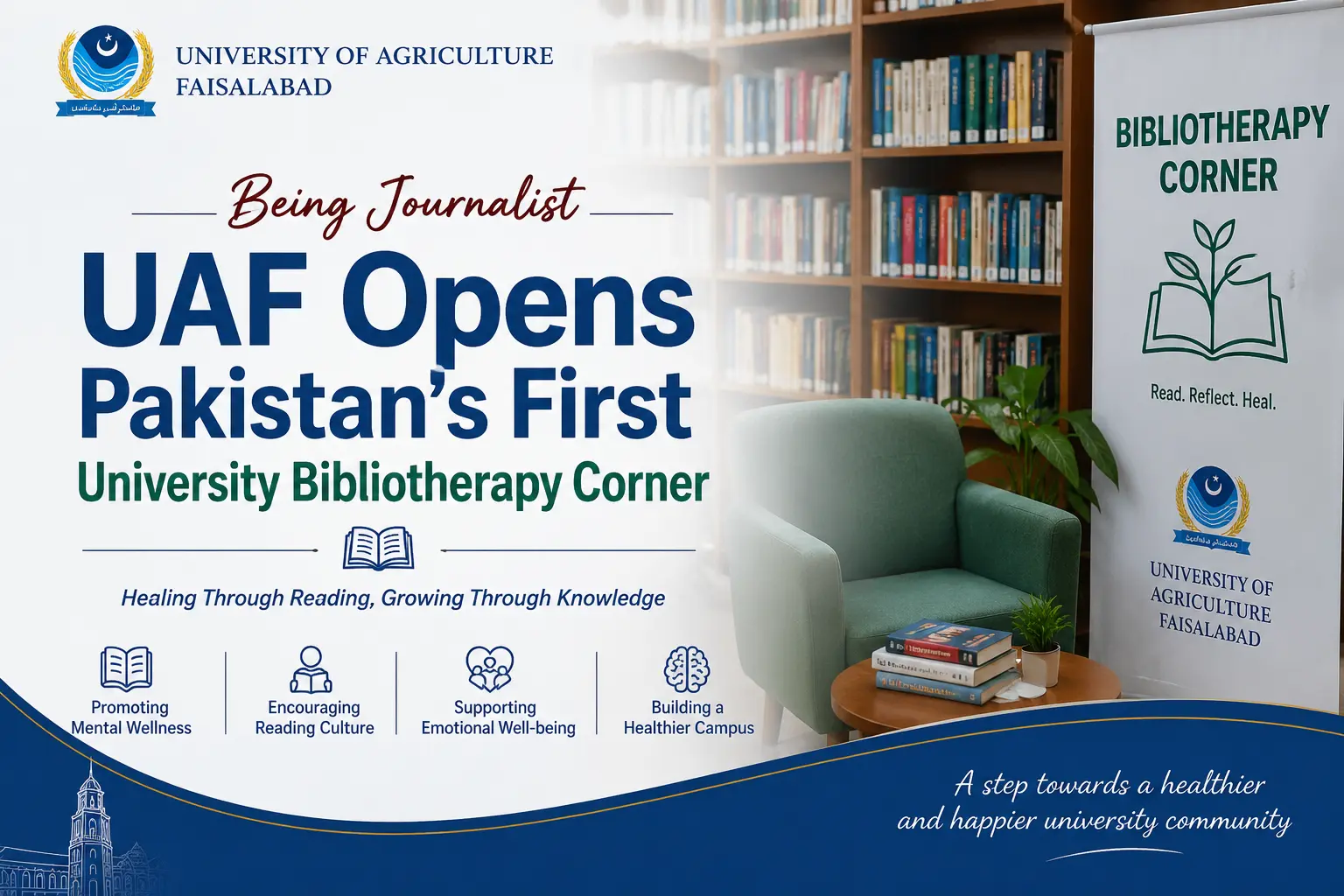
UAF Opens Pakistan’s First University Bibliotherapy Corner, The University of Agriculture Faisalabad has done something quietly radical. Nestled inside its Main Library, a new corner has opened — not for research papers or textbooks, but for healing. The Bibliotherapy Corner, launched in partnership with mental health organization Health 360, turns the act of reading into a structured therapeutic practice for students navigating the pressures of university life.
Bibliotherapy — the use of carefully selected books to support emotional well-being — is not new to clinical psychology. But embedding it directly into a Pakistani university library, staffed by a psychologist and backed by an institutional partnership, marks a meaningful shift in how higher education here approaches student mental health.
“A significant step toward promoting the psychological health and emotional well-being of students.” Vice Chancellor Prof. Dr. Zulfiqar Ali
More than a reading list
The corner stocks a curated selection of biographies, fiction, and self-help titles — each chosen not just for literary value, but for its capacity to build empathy, sharpen critical thinking, and offer students a mirror for their own experiences. The collection specifically addresses four pressure points that define modern student life: academic stress, social isolation, financial strain, and digital overload.
Free counseling included.
Clinical psychologist Ms. Iqra Nafees — an alumna of the English Access Scholarship Program — will provide free counseling sessions to students, using books as a therapeutic entry point. The service is available to all UAF students at no cost.
A signed promise, not just a symbolic launch
UAF and Health 360 formalized their collaboration with a Letter of Intent signed by Vice Chancellor Prof. Dr. Zulfiqar Ali and Health 360 CEO Ansar Mushtaq. The LoI spans mental health awareness, psychological services, capacity building, research, training, and community outreach — framing this as an ongoing institutional partnership rather than a one-off event.
The signing was witnessed by a broad group of university leadership, including Dean Prof. Dr. Rao Zahid Abbas, Librarian Mr. Muhammad Umar Farooq, Director External Linkages Dr. Muhammad Tehseen Azhar, and Registrar Prof. Dr. Muhammad Kamran Asif — signaling faculty-wide buy-in across departments.
Punjab’s universities could follow
The initiative has caught the attention of the Punjab Higher Education Commission (PHEC), which is now planning to scale bibliotherapy across universities province-wide. The model involves training librarians to collaborate with psychologists and counselors — turning existing library infrastructure into a mental health delivery channel without requiring new buildings or large budgets.
This scalability is exactly what makes the UAF model worth watching. By working within systems that already exist — libraries, trained staff, academic partnerships — the program offers a replicable blueprint that doesn’t depend on exceptional resources. For a country where university mental health services remain underfunded, that matters enormously.
Why it works: Bibliotherapy lowers the barrier to seeking help. For many students, picking up a book feels far less daunting than walking into a counselor’s office. The reading space creates a natural, non-clinical entry point — and Ms. Nafees will be there to take it further when students are ready.
Aligned with UN Sustainable Development Goal 3 on Good Health and Well-Being, the UAF Bibliotherapy Corner is a small room with large ambitions. Whether it becomes a model for Pakistan’s higher education system — or remains a one-campus experiment — will depend on how seriously institutions across the country take the mental health of the students walking through their doors every day.